interview: “Reminiscence” exhibition
Channel 4, Iran Broadcasting (September 2013).


Foad Alijani: I graduated from Isfahan University of Art and am now studying at Soreh University of Art. It has been nearly a decade since I entered the art field academically. My first experience was in applied art, inspired by Iran’s art history, but over time, I gradually shifted to contemporary art.
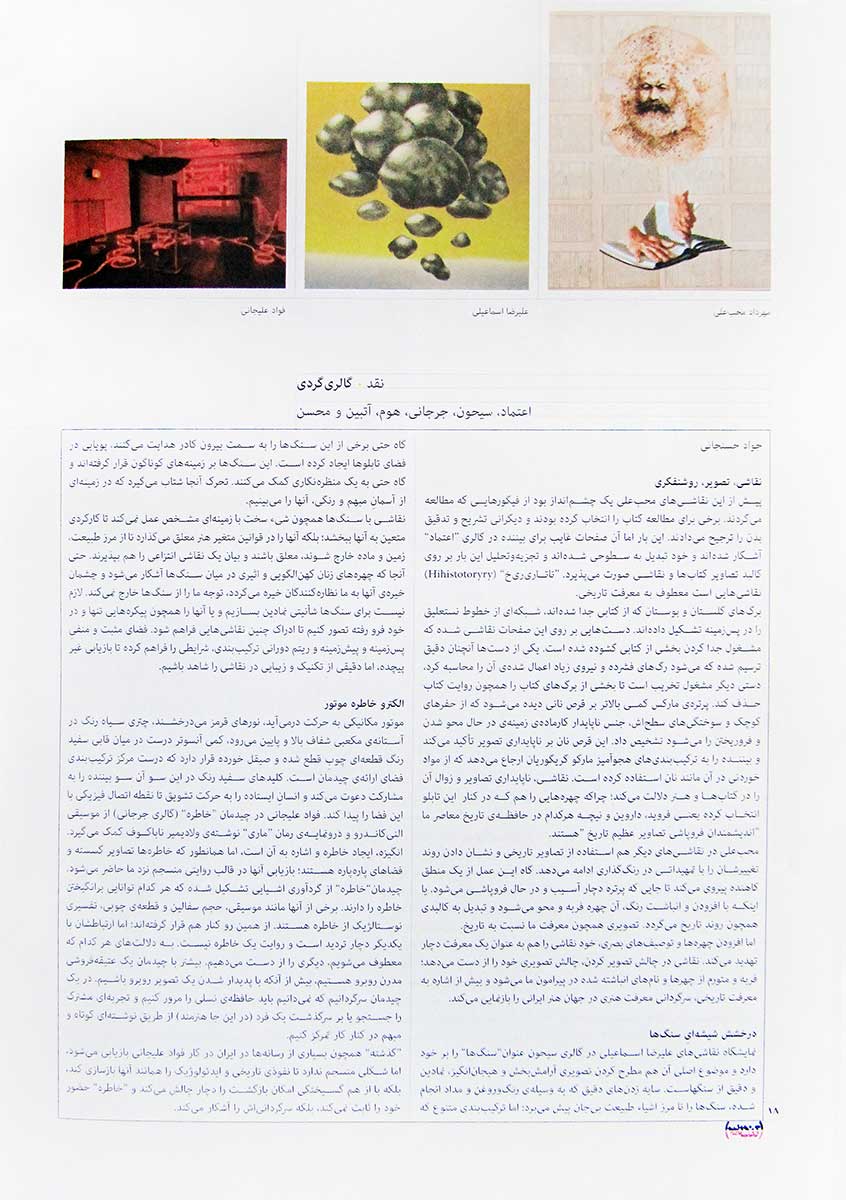
About this exhibition, there was a period when I was involved with the subject of Memory, and I think there are two kinds of memories: simple and usual memory and reflective memory that is beyond the experience. I found this through mental exploration of people and myself, so I use reminiscence for this kind of memory. Then I pondered and interpreted it until I converted it into visual expression.
When we confront this subject, the basic question that comes to mind is that usually, memory is a kind of nostalgic and smooth experience related to the past. So it is usually interpreted coldly. Here I chose the opposite sense and incorporated red color into my action. I think this is close to reflective reminiscence. At this point, the red color was created. Actually, an artist’s visual language is good at viewing and discovering things. I was thinking about this color and line for a while. Maybe I saw this line in the street or somewhere else, and it reminded me of stars and events that happen during a human’s lifetime. Each light refers to an incident and memory inside me. So this was the first visual root for this exhibition.
The next elements which I installed in this exhibition are an MDF wooden box and a glass box. The first box is a window of time, and an aquarium with water is used because water is the origin of creation. It is located in front of the time’s window. This is a space for a stream of reminiscences. There are some witches’ lights, which are linked to the light box and to the moving umbrella. So I gave a chance for the audience to get involved with the atmosphere. It is not important how many audience members participate, because I think the audience is free to have their own participation and interpretation.
What has happened in contemporary art is that the boundaries between the mediums have been removed. The important point is that the interpretation of this art depends on space and time. Before I came to the gallery, I walked along the path several times to check the way the audience would pass to reach the gallery.
I consider this part of my creation before the audience enters the space. What happened was the performance, my position with a sense of the idea of the work in the gallery, and playing with lines. I tried to immerse myself in my memory during the performance. I chose silence and began to delve into my memory and the things that happened to some of the audience who got involved with it, and they participated in this data sharing. I wanted something similar to happen to the audience. That part involved playing with lines. I emphasize that I do not want the audience to reach the result and the main idea I had.
Mahdi Khankeh (university professor): When we look at the definition of pioneers of installation art by Allan Kaprow, we encounter an amazing sentence: everything can be part of installation and each artwork can be an object that is used. Based on the definition of installation art after 40 or 50 years of Happening Art in Europe, we have a solid definition that we can follow. Conversely, when we enter the gallery and look at the creation of the artist, we understand that Foad Alijani tries to share his mental concepts, which he named installation. It means putting objects together and sharing different mediums in one composition or a combination of mental concepts with the audience.
When these interpretations and concepts that the artist has in his mind are complete, he enters performance art. This means that the artist tries to play with objects that he sets on the stage, and this play transfers concepts that the artist wants to convey to the audience. So Foad Alijani starts with a medium called installation and then enters conceptual art, then forms of happening art, and in this way, he can communicate with the audience. The effect of music in conveying the artist’s message to the audience, when we look at its background in art trends, is crucial.